
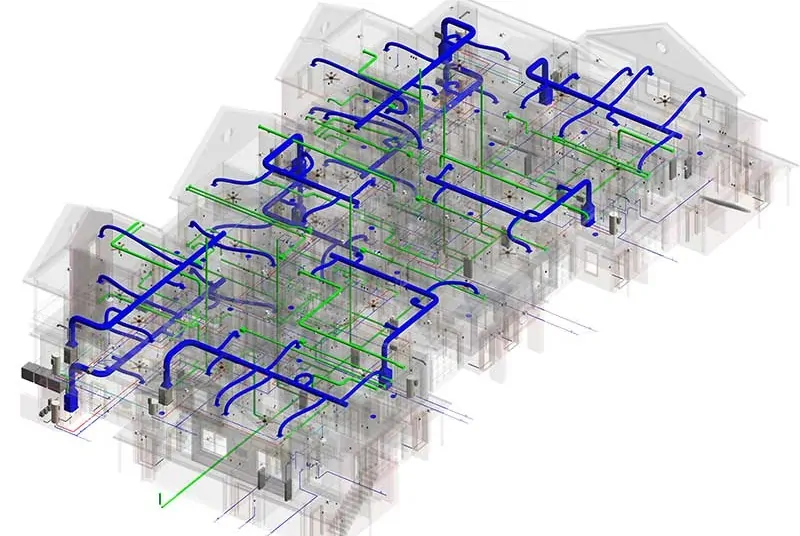
HVAC duct offset problems are one of the most overlooked issues in BIM coordination.
They don’t usually show up as major clashes. They don’t stop a coordination meeting. And in most models, they look like they’ve already been handled.
But in the field, those same offsets are a consistent source of delays, rework, and unexpected costs across MEP projects.
It’s not the offset itself that causes the problem. It’s how it’s coordinated.
What are HVAC duct offset problems in BIM coordination?
In BIM coordination, a duct offset is used to shift ductwork around structural elements, piping, or electrical systems.
On the surface, it’s a normal part of routing.
But HVAC duct offset problems happen when those adjustments are made without fully coordinating how they impact the rest of the system.
That includes:
- -Limited installation space once insulation and hangers are added
- -Conflicts with nearby trades that weren’t updated
- -Tight clearances that don’t reflect real-world conditions
- -Unnecessary bends that impact airflow performance
According to SMACNA guidelines, duct design should consider both efficiency and constructability. When offsets are added without that level of review, they create issues that won’t show up until installation begins.
Why duct offset issues lead to costly MEP rework
HVAC duct offset problems rarely stay isolated.
Once installation starts, even a small coordination gap can create a chain reaction across multiple trades.
Crews may run into:
- -Duct sections that don’t fit as fabricated
- -Interference with cable trays or fire protection systems
- -Insufficient space to install or access components
At that point, the solution is no longer a quick model adjustment. It becomes field rework.
That can mean:
- -Re-fabricating ductwork
- -Rerouting systems on-site
- -Delaying other trades waiting in sequence
Guidance from the National Institute of Building Sciences consistently identifies coordination gaps as a leading cause of construction rework. Duct offsets are a common example of how small modeling decisions turn into real jobsite costs.
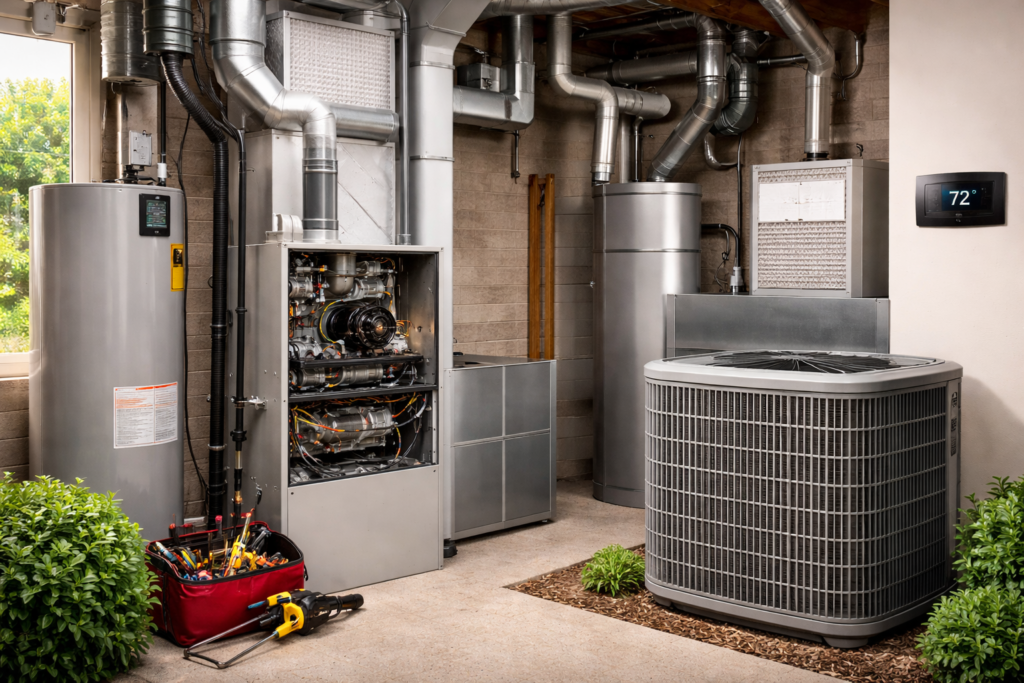
Where BIM coordination breaks down
Most HVAC duct offset problems don’t come from a lack of effort. They come from how coordination is handled under time pressure.
–Offsets are used as quick fixes
Instead of resolving the root clash, the duct is shifted just enough to pass coordination. That solution often isn’t reviewed holistically.
–Clearances are based on the model, not reality
The model may show space, but it doesn’t always account for insulation, supports, or installation tolerances.
–Trades aren’t fully re-coordinated
One adjustment can impact multiple systems, but not every trade revisits its routing after a change.
System performance isn’t considered
Frequent offsets increase resistance and can reduce airflow efficiency, as highlighted in ASHRAE best practices.
How to avoid HVAC duct offset problems
Avoiding these issues doesn’t mean eliminating offsets. It means coordinating them correctly from the start.
Effective BIM coordination includes:
–Solving clashes at the system level
Instead of adjusting one duct, look at how all systems can be routed together more efficiently.
–Validating real-world installation space
Include insulation, hangers, and access requirements in every coordination decision.
–Re-coordinating after every routing change
Any adjustment should trigger a review across all affected trades, not just the one making the change.
–Reviewing airflow impact
Minimizing unnecessary offsets helps maintain system efficiency and long-term performance.
Resources from Autodesk reinforce that BIM coordination should go beyond clash detection and focus on constructability and real-world execution.
Why does this matter in real projects?
HVAC duct offset problems don’t usually show up as major issues in reports.
They show up in the field as:
- -Slower installs
- -Crew frustration
- -Extra labor hours
- -Material waste
And because they’re small individually, they often go unnoticed until they start stacking across the project.
That’s where budgets and schedules quietly take a hit.
How BIMWERX helps prevent MEP rework
This is exactly where detailed BIM coordination makes the difference.
At BIMWERX, duct routing isn’t just reviewed for clashes. It’s evaluated based on how it will actually be installed.
That includes:
- -Confirming real installation clearances
- -Coordinating across all trades, not in isolation
- -Reviewing routing decisions for efficiency and constructability
- -Making sure updates are fully aligned before construction begins
The goal isn’t just to make the model look correct.
It’s to make sure the build goes smoothly without rework.
Final takeaway
HVAC duct offset problems in BIM coordination are easy to overlook, but expensive to ignore.
They sit in that space between “looks fine in the model” and “doesn’t work in the field.”
And on fast-paced MEP projects, that gap is where rework happens.
When coordination is done right, those problems never make it to the jobsite.
That’s the difference BIMWERX is built to deliver.