
Ludlam Trail
A seven-story mixed-use project in Miami featuring ultra-luxe apartments, parking, amenities, and retail, supported by BIMWerx mechanical and plumbing modeling, coordination, and shop drawings.
Coordinating a Large Mixed-Use Multifamily Project
Ludlam Trail required careful mechanical and plumbing coordination across a seven-story midrise with apartments, retail, amenities, and parking.
Altis Ludlam Trail
Altis Ludlam Trail is a mixed-use project located in the Bird Road development area in Miami, Florida. Ludlam Trail comprises 312 ultra-luxe apartments with an average size of 820 square feet.
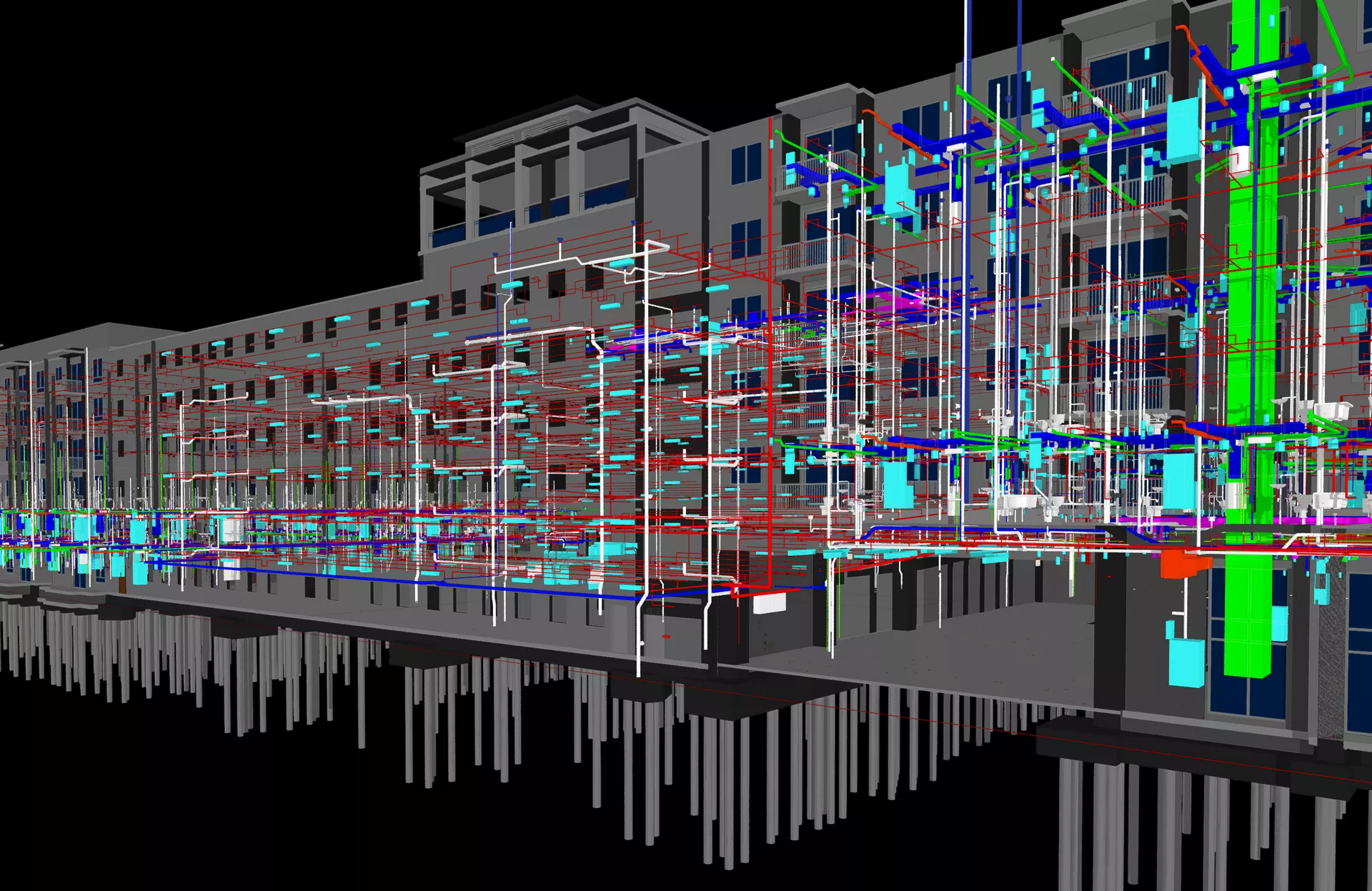
The seven-story midrise contains 323,745 gross square feet of apartments, a parking garage, amenities, and retail. The design of the building splits it into three sections, with the parking garage in the middle.
The structure of the building is primarily pile caps and grade beams below grade, and concrete columns, beams, CMU, and shear walls above grade, supporting 6” concrete slabs on each floor.
The project was designed in 2D AutoCAD, and there was not any 3D coordination done before BIMWerx’s involvement. The owner hired a third party to create the architectural and structural models for coordination purposes.
BIMWerx was hired to coordinate the trade contractors and provide mechanical and plumbing modeling, coordination, and shop drawings. Throughout the course of the project, BIMWerx updated the architectural model to incorporate ceiling modifications needed to facilitate a coordinated model.
Visualizing Coordination Across Multiple Building Zones
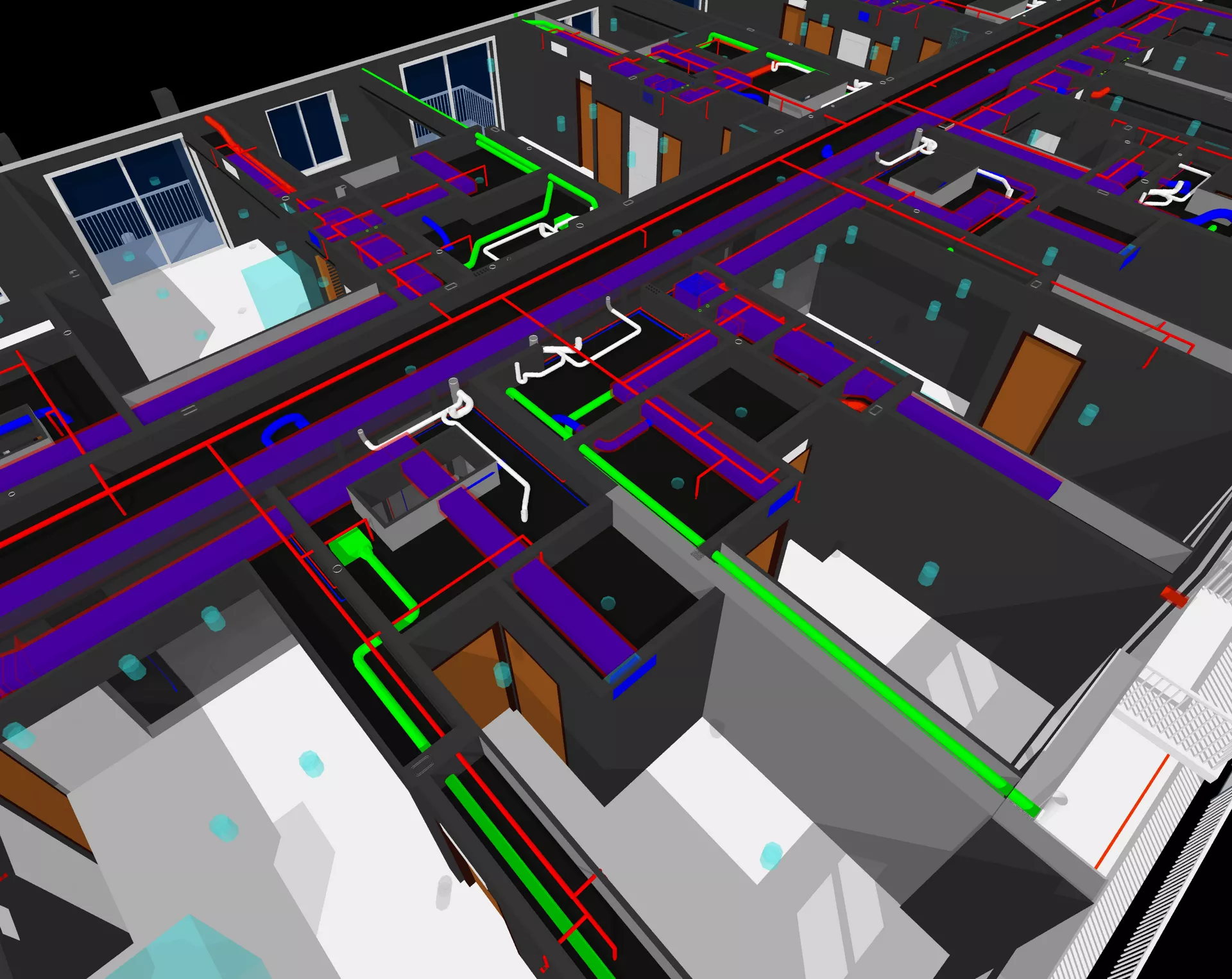
Mixed-use multifamily projects depend on clean coordination between structure, units, overhead spaces, mechanical closets, plumbing stacks, electrical routing, and fire protection systems.
Solving Tight Overhead Spaces and Trade Conflicts
The project was straightforward in some ways, with a consistent layout for most levels. However, the structure posed many obstacles due to the location and depth of the concrete beams.
Many workarounds were needed because of toilet and plumbing stack locations. The floor-to-floor heights also created challenges throughout the building, especially where sanitary piping connecting showers and tubs to toilets was limited by ductwork, all trying to fit into tight overhead spaces.
In most units, the mechanical closets were adjacent to the washer and dryer closets. These areas attempted to utilize the demising wall between them to locate the dryer box and hookups, along with refrigeration, condensation drains, and domestic water lines.
Reducing Coordination Time With Multiple Trades Under One Roof
The process took approximately 16 weeks and close to 640 hours to complete. BIMWerx was made aware on multiple occasions that the advantage of using BIMWerx over trade contractors was the uniqueness of having multiple trades under one roof.
This approach effectively reduced coordination time and helped the team stay ahead of the construction team.
Project Impact
Need BIM Support for a Mixed-Use or Multifamily Project?
BIMWerx helps project teams coordinate mechanical, plumbing, electrical, and fire protection systems before field installation begins.